Ward Lumber in Jay, NY now has Sweetlix Meatmaker 16:8 loose minerals for goats in stock! It is normally a special order item and can take a while to get in. They are selling it for about $23 for a 25 lbs. bag. One bag will last a couple of goats for a month or more. Sweetlix Meatmaker is one of the best mineral blends on the market for all types of goats (not just meat goats).
Go pick up some loose minerals today!
Don't forget -- Ward Lumber in Jay will deliver feed and other animal supplies to your farm free of charge every two weeks. To get on the delivery list, go to www.wardlumber.com.
Monday, June 18, 2012

Thursday, June 14, 2012
Rotational Grazing
From the Premier 1 Fence company monthly newsletter:
Pasture Management
Is It Worth The Effort?
Is It Worth The Effort?
by Byron Leu
Beef Production Specialist
Iowa State University Extension and Outreach
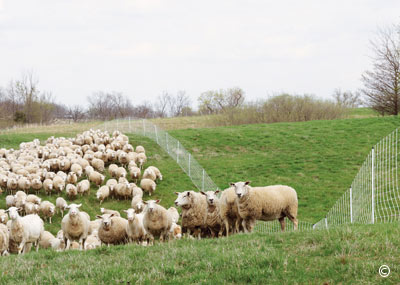
Recent trends in the agricultural sector have led to a number of challenges for livestock producers in the Midwest. Grain prices and land values have both significantly increased over the past several years. These historically high prices have created a number of issues especially for beef cow-calf and sheep producers. The higher land prices are pressuring producers to incur higher grazing costs and pasture rental payments. In some instances, this cost has increased 20% to 50% for the grazing period. Also, high grain prices are creating land-use competition-with many producers considering planting grain crops on traditional forage ground to take advantage of the current high grain prices. These considerations are forcing livestock producers to explore methods to improve pasture production per acre in order to maintain their livestock enterprises-not only to control grazing costs per unit but also to produce adequate forage production in a cost-effective system.
Obviously there are numerous approaches that can be incorporated into an operation that address these production and economic challenges. Due to limited space, we can't explore them all-but let's look at several basic options:
Beef Production Specialist
Iowa State University Extension and Outreach
Recent trends in the agricultural sector have led to a number of challenges for livestock producers in the Midwest. Grain prices and land values have both significantly increased over the past several years. These historically high prices have created a number of issues especially for beef cow-calf and sheep producers. The higher land prices are pressuring producers to incur higher grazing costs and pasture rental payments. In some instances, this cost has increased 20% to 50% for the grazing period. Also, high grain prices are creating land-use competition-with many producers considering planting grain crops on traditional forage ground to take advantage of the current high grain prices. These considerations are forcing livestock producers to explore methods to improve pasture production per acre in order to maintain their livestock enterprises-not only to control grazing costs per unit but also to produce adequate forage production in a cost-effective system.
Obviously there are numerous approaches that can be incorporated into an operation that address these production and economic challenges. Due to limited space, we can't explore them all-but let's look at several basic options:
Evaluate your forage base
- Will your current pasture species provide adequate production and quality levels to meet your animal's performance and nutritional needs throughout the grazing period? What are the weaknesses?
- Are legumes a part of your traditional grass-based pastures? Studies have shown that legumes can contribute to improved animal performance and also provide nitrogen for grass growth. Trials reflect that pasture stands of 2/3 grass and 1/3 red clover have shown similar production levels as N-fertilized grass. Also, researchers have shown that incorporating legumes into unimproved grass pastures increase pasture production over 30%. End result-increased animal performance, improved pasture productivity, and potentially lower fertilization expenses.
Develop a workable system
- What system is best for you? The main point to this question is that if you are attempting to improve productivity and utilization rates, then it is recommended to consider some sort of rotational system. If you compare a rotational system with 4 to 5 paddocks to a continuous grazing program, you can expect a production increase of 15%. Double the number of paddocks (i.e., 8 to 10), and you can pick up another 15%. Without question, some level of rotational grazing can have a positive impact on your bottom line and strengthen the competitiveness of your grazing operation.
Phase out continuous grazing
- Why? University tests have shown that animal gain per acre increased an average of over 40% in rotational systems when compared to continuous grazing. Plus, a University of Georgia study indicated a 36% increase in stocking rate and calf gain per acre when comparing rotational grazing to continuous grazing-with no difference in conception rates or individual calf weaning weights. Add in the potential of improved plant persistence, forage productivity, and manure distribution. So why not consider abandoning the continuous approach?
Balance your system to match your resources
- This is key to the success of any grazing system. Utilize and incorporate the information and resources that you have available. This includes management approaches such as adjusting paddock size/location, frost seeding/interseeding, new watering strategies, incorporating a different grazing system approach, early weaning, trying new forage varieties-the options are extensive. Plus, don't forget the basics-manage both the production side as well as the expense side of the equation.
Tuesday, May 22, 2012
July Event
The next ADK Goat Club event will be "Goat Night" on July 10, 2012 at 6:30pm at Ward Lumber in Jay, NY. Rose Bartiss will be giving a presentation titled "Tips on Goat Keeping". There will be free pizza and soda. There will also be door prizes! Please register for the event by going to www.wardlumber.com.
Monday, May 21, 2012
May Meeting Wrap-Up and July Event
With the hot and sunny weather on Sunday, I think people must have
decided to stay home and play with their goats instead of going to the
Goat Club meeting. Only Gail and I were in attendance. We talked goats
and ate some delicious goat cheese pasta and goat milk pudding pie.
Gail's goats were happy to entertain us with their goaty antics.
The next ADK Goat Club event will be on July 10, starting at 6:30pm, at Ward Lumber in Jay, NY. I will be giving a presentation titled "Tips on Goat Keeping". Ward Lumber is sponsoring the event. There will be free pizza and soda. There will also be door prizes! Please register for the event by going to www.wardlumber.com. I hope to see all of you there!!!
-Rose
Thursday, May 10, 2012
May Meeting Location
The ADK Goat Club will have a meeting on May 20 from 12pm - 3pm at Gail Huston's house in Bloomingdale. For directions, please contact her at adirondackdogs(at)verizon.net.
I hope to see you there!!
I hope to see you there!!
Friday, May 4, 2012
Meeting: May 20, 2012
The next ADK Goat Club will have a meeting on May 20, 2012 from 12pm - 3pm. I am not sure of the location yet but I will post as soon as I know. Thanks!
Tuesday, April 24, 2012
May Meeting
The ADK Goat Club will have a meeting in May. I am currently looking for someone to volunteer to host the meeting at their farm. The theme of the meeting will be "Milk and Milking". Please let me know if you would like to host. Also let me know what date/time in May works for you.
We will have a milk recipe contest at the meeting. Bring your favorite dish that includes goat milk. The three best dishes will win a prize!
We will have a milk recipe contest at the meeting. Bring your favorite dish that includes goat milk. The three best dishes will win a prize!
Subscribe to:
Posts (Atom)